Us media: like a seal diving and sleeping to prevent the enemy from "killing three birds with one stone"
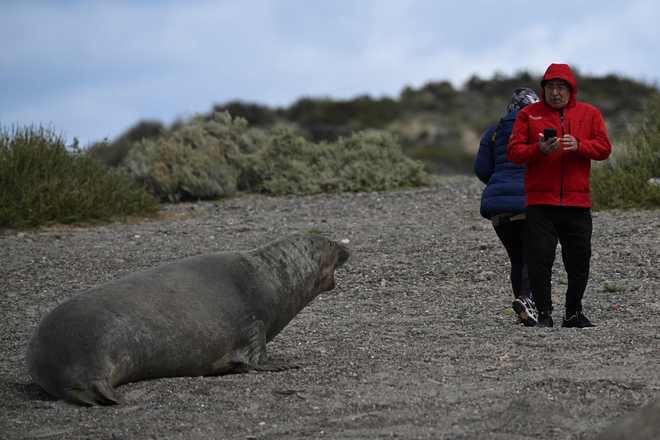
Reference News Network reported on April 23, According to the US Capitol Hill website reported on April 20th, a new study found that elephant seals avoid predators by sleeping while diving.
This research, published in the American magazine Science on the 20th, enables people to further understand the general demand for sleep of mammals and the reasons why elephant seals, which have been rounded up for thousands of years, have survived to this day.
This large aquatic mammal can stay in the sea for up to seven or eight months at a time, and most of the time it dives into the depth of hundreds of meters below the sea surface.
Daniel Costa, of the University of California, Santa Cruz, said that this constant activity prompted people to ask questions.
He said: "Whether they stay in the sea for two and a half months or eight months, look at the diving records. They dive again and again-stay underwater for 20 minutes or 25 minutes, then return to the surface, and go back and forth. So, when do they all sleep? "
To answer this question, the research team installed electrodes to monitor the brain of wild elephant seals.
They found that elephant seals repeatedly take naps when diving to regain their energy-they fall into deep sleep during the long journey to the underwater fishing ground.
Then, they wake up at the bottom of the sea and start fishing until there is not enough oxygen, then they surface and start the whole process again.
This means that sleep apnea, a potentially fatal situation for humans, can save lives for seals.
Sleep apnea is a technical term to describe the disease of respiratory arrest during sleep, which may be fatal to humans. But for seals, this is a normal link in the development process. Costa said that after a few months of birth, elephant seal cubs "often hold their breath while sleeping."
Costa also said: "If we understand how the basic components of the normal sleep function of elephant seals regulate the sleep cycle, we may be able to understand to some extent what happened when humans entered the sleep apnea state."
On the other hand, the strange sleep patterns of elephant seals are actually more like humans than other marine mammals.
Scientists have found that elephant seals sleep so deeply when diving that they go into rapid eye movement sleep-a sleep stage marked by dreaming and physical paralysis for humans.
Dolphins and small, hairy seals can’t take a thorough nap underwater. Instead, they use "hemispheric" sleep, that is, only half of their brains go to sleep at a time.
In contrast, elephant seals sleep more like humans. Why don’t they take turns sleeping with their brains like dolphins and other seals?
Costa said: "I guess this is because they don’t have to do this. I also guess that going deep into the sea floor is a much more effective way to avoid being hunted. " He pointed out that the diving ability of elephant seals is much better than that of other species.
The unique sleeping habits of elephant seals highlight the upside-down marine geographical environment experienced by aquatic mammals: they must constantly return to the surface to breathe air, but the surface of the sea is a dangerous place, even for the largest member of the seal family, which can weigh up to 2 tons.
Elephant seals have a lot of oil in their bodies, which makes them the coveted prey of predators who are eyeing the sea in droves, including killer whales with high IQ and great white sharks swimming everywhere, as well as-historically-human crew.