
Experts introduced the latest research results in the experimental field of wheat research institute of Brazilian agriculture and animal husbandry research company. People’s Daily reporter Zhang Yuannan photo

In July, 2020, an unmanned aerial vehicle (UAV) flew over a self-driving combine in a digital agricultural experimental field in Belges.
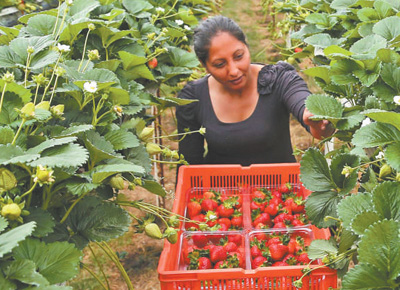
In September 2020, a Romanian farmer picked strawberries in a greenhouse. Information picture

A farmland scenery in Saga Prefecture, Kyushu, Japan.
image china
By cultivating and popularizing excellent varieties, speeding up the development of digital agriculture and deepening international cooperation in agricultural science and technology, many countries have promoted the deep integration of agriculture and science and technology, promoted the efficiency and quality improvement of agriculture, and better served the national economic development and agricultural modernization.
Japan
Encourage researchers and farmers to cultivate new plant varieties.
Liu Junguo, correspondent of People’s Daily in Japan
"A few years ago, I never thought I could sell strawberries to Tokyo. Now, our strawberries are very popular in markets such as Tokyo, and I am full of confidence in future sales. " Chai Tian Zhi Ming, 56, is a strawberry grower in Okayama City, Okayama Prefecture. At present, he is busy picking a new strawberry variety called "raspberry". In Tokyo, a box of 15 "raspberries" costs around 10,000 yen (1 yuan RMB is about 16 yen).
Okayama Prefecture has a long sunshine time and is a famous fruit town in Japan. In the past, influenced by seasons, winter and spring were the off-season of fruit production every year. In recent years, the county has focused on supporting strawberry planting and developing new varieties of strawberries, which has enabled Hajime Okayama to keep fruits all year round, further enhancing the brand value of the land of fruits.
The quality control of "raspberry" is very strict. Every grain should be tested, and the weight of each grain should be more than 30 grams, and the requirements of shape, color and luster should be met. In addition to "high value", "raspberry" is also the crystallization of agricultural high technology. Under the careful cultivation of scientific research personnel of Kyushu Okinawa Agricultural Research Center, "raspberry" has the advantages of high sugar content, high yield, suitability for cultivation and high vitamin C content. Generally, strawberries contain 60 milligrams of vitamin C per 100 grams, and the content of "raspberries" reaches 87 milligrams.
The birth of "raspberry" is a vivid case of Japanese agricultural researchers integrating theory with practice. Japan has limited land resources and a large demand for agricultural products. The Japanese government has been committed to improving land output and improving the quality of agricultural products through science and technology. Since 2003, the Ministry of Agriculture, Forestry and Fisheries of Japan has started to implement a scientific research project, which divides agricultural products into six major categories, such as wheat, soybean and vegetables, focusing on "health-enhancing crops" and "crops with reduced environmental load". The research and development of "raspberry" belongs to a sub-topic of "vegetables", aiming at meeting consumers’ demand for vegetables rich in vitamin C.
In addition to the Japanese central government, Japanese local governments are also committed to cultivating new fruit varieties. In November 2019, the strawberry variety — which was developed by Miyagi Agricultural and Horticultural Research Institute for 12 years; — "Smiling Berry" officially entered the market. "Smiling Berry" has a bright color and a conical shape, and it has been favored by many consumers as soon as it is listed. What makes strawberry growers happy is that this kind of strawberry is easy to take care of, and its output is 30% higher than that of ordinary strawberries, which effectively drives farmers to increase their income.
In Japan, apples, oranges, grapes and other common fruits are listed almost every year. In the famous hometown of apples in Japan — — In Aomori Prefecture, farmer Sakura Tingbao spent 14 years cultivating a new apple variety called "Mingqiu". "Mingqiu" is bigger than Fuji apple, with brighter colors and shorter growth period by half a month. “‘ Mingqiu ’ Apples are easy to color, and no bagging is needed, which can save a lot of effort. " Sakura Tingbao, who is nearly 90 years old, believes that with the aging of local fruit farmers, planting this high-quality apple will help solve the problems such as labor shortage.
In order to further promote the research and development of new varieties, Japan introduced a variety registration system to encourage researchers and farmers to actively cultivate new plant varieties. Breeders of new plant varieties submit applications to the Ministry of Agriculture, Forestry and Fisheries, and after being approved for registration, they can get a protection period of 25 to 30 years. During the protection period, farmers who plant new varieties should pay the use fee to the breeder of new varieties, so as to protect the rights of the breeder of new varieties.
(People’s Daily, Tokyo Electric)
Germany
Establishing digital experimental field to promote the application of new technology
Hua Fang, reporter of People’s Daily in Germany
Unmanned aerial vehicles (UAVs) equipped with spectral cameras are flying over the fields, and many white sensing devices are arranged in order in the fields. In the laboratory not far away, scientists are analyzing the growth state of wheat and beet in the fields according to the information sent back by various instruments … … This small farmland is located in Gö ttingen, a city in central Germany, and has a unique name — — Digital experimental field of "farmer space"
"Plant pests and diseases affect the land harvest. What we do is to use advanced digital technology to find and identify pests and diseases as soon as possible and find accurate and effective solutions." Project coordinator Anne — Catelyn Mahlein introduced the research focus of "farmers’ space" to reporters. The Internet of Things sensor is installed in the experimental field, which measures the temperature and humidity of soil layers with different thicknesses every 10 minutes, and summarizes the monitoring data through wireless network. These data will help researchers lock in the specific time and location of crop diseases and insect pests. Mahlein said that this will help to avoid large-scale pesticide spraying in the later period. In the future, advanced agricultural machinery can also be used for regional protection, thus protecting farmland and improving harvest.
The "Farmers’ Space" project was jointly established by the Sugar Beet Research Institute of the University of Gö ttingen and the Department of Agricultural Technology. The project is funded by the German Federal Ministry of Food and Agriculture (hereinafter referred to as the German Ministry of Agriculture) for about 2.5 million euros, which is one of the 14 digital agriculture pilot projects funded by the Ministry. The German Ministry of Agriculture plans to invest more than 50 million euros in three years to promote the development of digital agriculture through the establishment of experimental fields. Researchers carry out research on the application of digital technology in farming and animal breeding in the field, so as to better use digital technology in all aspects of agricultural production, protect the natural environment, improve animal welfare, promote biodiversity and reduce farmers’ workload, and then promote the sustainable development of the whole society.
Digital agriculture demonstration field project not only improves the production efficiency of traditional agriculture, but also improves farmers’ acceptance of digital technology. In the "farmers’ space", farmers can directly see the clear farmland map on the screen inside the tractor. It is clear at a glance which field needs to be sprayed with pesticides and which land has sufficient fertility. Stephan paulus, a data expert at Sugar Beet Research Institute, said that the popularization and application of new technologies are not always smooth. In the "farmers’ space", experts promote the application of new technologies by explaining and demonstrating them to farmers. According to the latest data of German Information Technology, Telecommunications and New Media Association, 80% of farms in Germany have adopted various forms of digital technology in the agricultural production process.
In order to give full play to the advantages of digital agriculture, the German Ministry of Agriculture has specially formulated the future plan of "Agricultural Digital Policy". By the end of 2022, it is planned to allocate 60 million euros to promote the digitalization and modernization of agriculture, which is itself an important part of the German government’s digital implementation strategy. In addition, the German government also plans to invest 45 million euros to promote the application of artificial intelligence in agriculture, rural areas and healthy eating.
(People’s Daily, Berlin)
Brazil
"Tropical" improvement of soybean seeds
Zhang Yuannan, reporter of People’s Daily in Brazil
"When I first took over the farm in the 1970 s, I could only harvest about 900 kilograms of soybeans per hectare, but now the output per hectare has reached 4.8 tons." In another month, Kalmu, a farmer in rio grande do sul, Brazil, will welcome the soybean harvest season. Looking at the touch of green in the field, Kalmu was beaming and seemed to have seen a good harvest this year.
For decades, Kalmu witnessed the rapid increase of soybean production on his own farm, and also witnessed that the annual soybean production in Brazil increased from less than 2 million tons in 1970 to 120 million tons now, ranking first in the world. "This is the power of technology!" Kalmu believes that improving the level of seeds and soil through science and technology plays a vital role in increasing income.
"Technology drives the development of Brazilian agriculture." Celso Moleti, President of Brazilian Agriculture and Animal Husbandry Research Company, is convinced of this. He believes that the key to Brazil’s substantial increase in grain output, including soybeans, is to use technology to "tropical" it. In 1973, in order to develop a tropical agriculture and animal husbandry model suitable for the local area and realize sustainable development, an agricultural and animal husbandry research company under the Brazilian Ministry of Agriculture came into being and played an important role in agricultural scientific research and technology promotion in the future.
Most of Brazil’s land is located in tropical and subtropical regions, with strong soil acidity and low fertility, and high temperature and humidity are easy to cause pests and diseases. Soybean is a temperate climate crop, which is sensitive to temperature change, and most of the main producing areas in the world are distributed in temperate regions. In view of this, the Brazilian Agriculture and Animal Husbandry Research Company cooperated with other domestic and foreign scientific research institutions to simulate the tropical climate conditions in central and western Brazil in the greenhouse experimental field, and hybridized and bred soybeans to cultivate new varieties that are suitable for tropical conditions and resistant to pests and diseases. After continuous improvement, the new soybean variety can adapt to the acidic soil environment in central and western Brazil, the growth cycle is shortened by 8 to 12 weeks, and the yield is also improved. Kalmu told reporters that the varieties of soybeans on the farm are constantly upgrading, and new varieties are listed every few years. "The optimization of soybean varieties is related to the livelihood of our farmers."
The improvement of soil is also inseparable from science and technology. After a series of scientific research, Brazilian Agriculture and Animal Husbandry Research Company neutralizes soil acidity by adding a large amount of agricultural gypsum or lime with relatively low cost to the soil; Biological nitrogen fixation technology is used to help crops fix nitrogen from the air, promote growth and reduce the use of chemical fertilizers. At the same time, the no-tillage method is popularized, and when harvesting crops, it is cut from the stem, leaving the roots in the soil to maintain soil fertility.
After getting rid of the restrictions of climate and soil, soybeans that could only be planted in the southernmost part of Brazil expanded in journey to the south, and the planting area and yield increased continuously. Today, soybeans can be grown in most parts of Brazil, extending as far north as the equator. The successful trial planting of soybeans in low latitudes is considered to be a technological revolution in Brazilian agriculture, which has changed the history of soybean planting. Since then, Brazil’s corn, wheat, pasture planting, and some livestock breeding have also been "tropical" improved. Agriculture and Animal Husbandry Research Company predicts that with the continuous expansion of wheat planting area in tropical areas, Brazil’s domestic wheat production will double and achieve self-sufficiency.
"Gene editing, bio-economics, agricultural intensification and digital agriculture are the focus of agricultural innovation." Moleti believes that the future of agricultural development depends on the continuous development of science and technology, and Brazil will continue to promote agricultural science and technology research.
(People’s Daily, Rio de Janeiro)
Romania
International cooperation in agriculture promotes the optimization of local planting structure
Yu Yang, correspondent of People’s Daily in Poland
Romania is one of the "granaries" in Europe, and its grain production has been in the forefront of Europe for many years. However, due to factors such as low production efficiency and single production variety, Romania needs to import a large number of cash crops and fruit and vegetable products from abroad, and the income of farmers is not satisfactory. In recent years, Romania has turned its attention to international cooperation in agriculture. More and more agricultural experts advocate improving the country’s agricultural production structure, raising the scientific and technological content of agricultural products and finding new income-increasing points for farmers.
In the experimental field of Bucharest University of Agricultural Sciences and Veterinary Medicine, there is a jujube tree from Shaanxi, China. Since taking root here in 1996, Romanian agricultural experts have grafted and cultivated more than a dozen new varieties on this jujube tree, and Romania has also taken the lead in introducing jujube trees from China to Europe.
According to florin Stanika, vice president of the school, the southern mountainous area of Romania has poor soil and arid climate, so it is difficult for local farmers to increase their income. "China has successfully increased farmers’ income and improved the ecological environment by planting cash crops in arid areas, which has inspired us a lot." Over the past 20 years, Stanika has been committed to the introduction and cultivation of jujube trees in China. "China jujube has high nutritional components and economic value. We hope that through cooperation with China, this fruit will be introduced to Europe, promoted in Romania, and a new way will be found to increase farmers’ income in poverty-stricken areas. " Stanika said.
Thanks to his efforts, the world’s first international joint laboratory in the field of jujube research in China settled in Romania, and some farms began to promote jujube planting on a pilot basis. Last October, Bucharest University of Agricultural Sciences and Veterinary Medicine, Hebei Agricultural University and Romanian Horticultural Society jointly held the "2020 Jujube Seminar" online, which became one of the highlights of agricultural cooperation between China and Romania during the epidemic prevention and control period.
"Agricultural science and technology innovation is the fundamental driving force for the development of modern agriculture and farmers to achieve prosperity. Today, with the deepening of globalization, only by strengthening the exchange and cooperation of agricultural technology between different countries and the exchange and flow between different markets can we promote the rational allocation and long-term development of agricultural resources in various countries. " Stanika said.
Also in this university, there is a greenhouse vegetable shed that is particularly conspicuous. This is the first China jointly built by the Institute of Agricultural Environment and Sustainable Development of Chinese Academy of Agricultural Sciences — Romanian agricultural science and technology park. There are 50 square meters of intelligent LED plant factory and 500 square meters of light, simplified and energy-saving solar greenhouse in the park. Intelligent LED plant factory uses LED energy-saving light source, shallow liquid nutrient solution three-dimensional cultivation and other technologies, with a cultivation area of 150 square meters and an annual output of 4,000 kilograms of leafy vegetables. Lightweight, simplified and energy-saving solar greenhouse can produce more than 8000 kilograms of fruits and vegetables per year by adopting active heat storage and temperature regulation, embedded soilless culture and other technologies.
Solina Petra, head of the Flower Experiment Department of Sino-Romanian Agricultural Science and Technology Park, said that the improved greenhouse can adjust the temperature by using light energy in winter, and the cost of construction and operation is greatly reduced. Improving the greenhouse makes it possible for Romanian farmers to grow fruits, vegetables and flowers in winter, which is helpful to promote the optimization of local planting structure.
"China’s agricultural development has made amazing achievements. Romania and China have strong complementarities in agricultural cooperation, especially China’s rural poverty alleviation experience and agricultural technology innovation model, which are worth learning from." Petra said.
(People’s Daily, Warsaw)