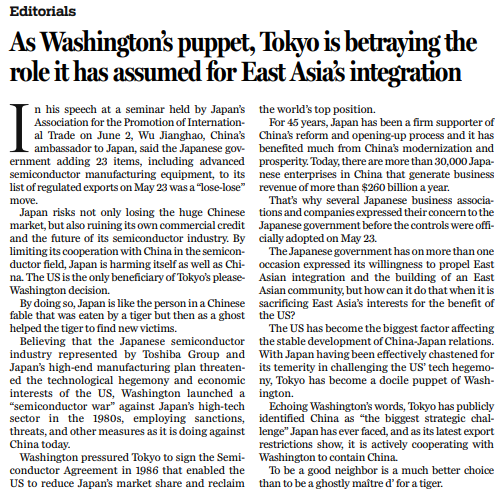
Recently, the Japanese government officially introduced export control measures for semiconductor manufacturing equipment, which will be implemented on July 23. If Japan can’t pull back from the brink and insist on being a tiger, it will probably eat its own fruit and let the United States reap the benefits.
China’s ambassador to Japan, Wu Jianghao, hit the nail on the head at the exchange meeting of the Japan Association for the Promotion of International Trade a few days ago. If Japan insists on imposing restrictions on Sino-Japanese semiconductor cooperation, it will lose not only China’s huge market, but also Japan’s own commercial reputation and the future of the semiconductor industry. The purpose of the United States is to re-establish its semiconductor hegemony. If we follow the routine designed by the United States, there will only be one result, that is, China and Japan "lose each other" and the United States wins alone.
Throughout history, the last time the United States launched a "semiconductor war" with great fanfare was precisely aimed at Japan. In the 1980s, the US government claimed that the Japanese semiconductor industry, represented by Toshiba Group, seriously threatened the economic interests of the United States, while Japan’s high-end manufacturing plan challenged the technological hegemony of the United States. The United States launched a "semiconductor war" against Japan’s high-tech industry on this ground, and finally forced Japan to sign the "US-Japan Semiconductor Agreement". Since then, Japan’s semiconductor industry has suffered greatly, and the United States has replaced it.
In contrast, China’s modernization has benefited Japan a lot. Today, there are more than 30,000 Japanese companies in China, with an annual revenue of about $260 billion. In view of this, many Japanese chambers of commerce and enterprises have expressed their concerns about the export control measures of semiconductor manufacturing equipment to the Japanese government.
The Japanese government has repeatedly expressed its willingness to promote the process of East Asian integration and the construction of the East Asian Community, but it has repeatedly sacrificed the interests of East Asia for the benefit of the United States. Now it seems that the United States has become the biggest obstacle to the stable development of Sino-Japanese relations. Japan has become a marionette of the United States, and even called China’s military development "the biggest strategic challenge ever" in order to cater to the open-eyed nonsense of the United States.
The export control measures of semiconductor manufacturing equipment show that Japan is going further and further on the road of cooperating with the United States to contain China. However, Japan should understand that good-neighborly friendship between China and Japan conforms to the fundamental interests and long-term interests of the two countries, and being in cahoots with the United States is tantamount to making an ill will, and will eventually reap the consequences.
This article is translated from the June 7th editorial of China Journal.
Original title: as Washington’s puppet, Tokyo is betting the roles have been assured for East Asia’s integration.
Produced by: Editorial Office of China Daily.
Compile: Yan Yujie
[Editor: Yan Yujie]